AI - Product
An AI that scores risk - Designing for trust
An analyst at a bank receives a risk score generated by AI. So why would they actually trust it?
A US bank needed to automate compliance checks before issuing a loan. The brief was straightforward: upload document → search public records, sanctions databases, credit histories → return risk score. The idea sounded clean.
But there was a hidden problem: an analyst isn't going to sign off on a loan because a screen told them to. If the AI gets it wrong—and it will—and there's no way to understand why, the analyst loses all judgment. And if the analyst doesn't trust the process, the system doesn't exist.
- Year
- 2026
- Industry
- Fintech
- Client
- US Bank (NDA)
- Role
- Product Designer
My role
I came in after the AI was built. The ask was "design the UI to show the result." I looked at what the agent could do—reasoning, cross-referencing sources, finding connections—and realized the problem wasn't the interface.
The problem was how to make a human trust a machine's decision.
So I proposed a different scope: don't show just the result. Show all the work. Let the analyst verify every source, dig into what concerns them, draw their own conclusions. The AI stops being a decision-maker and becomes a researcher preparing material for a human to decide on.
The scoring is still there. But it's a conclusion, not a verdict.
How I approached each decision
The project had four critical design decisions. Each one answered a question the analyst would ask themselves.
Where did this result come from?
Each source (OFAC, FinCEN, credit history, etc.) is a row the analyst can open. Not a tab—tabs force you to choose. A list that accumulates. The analyst sees what concerns them without drowning in data.
Who's connected to who?
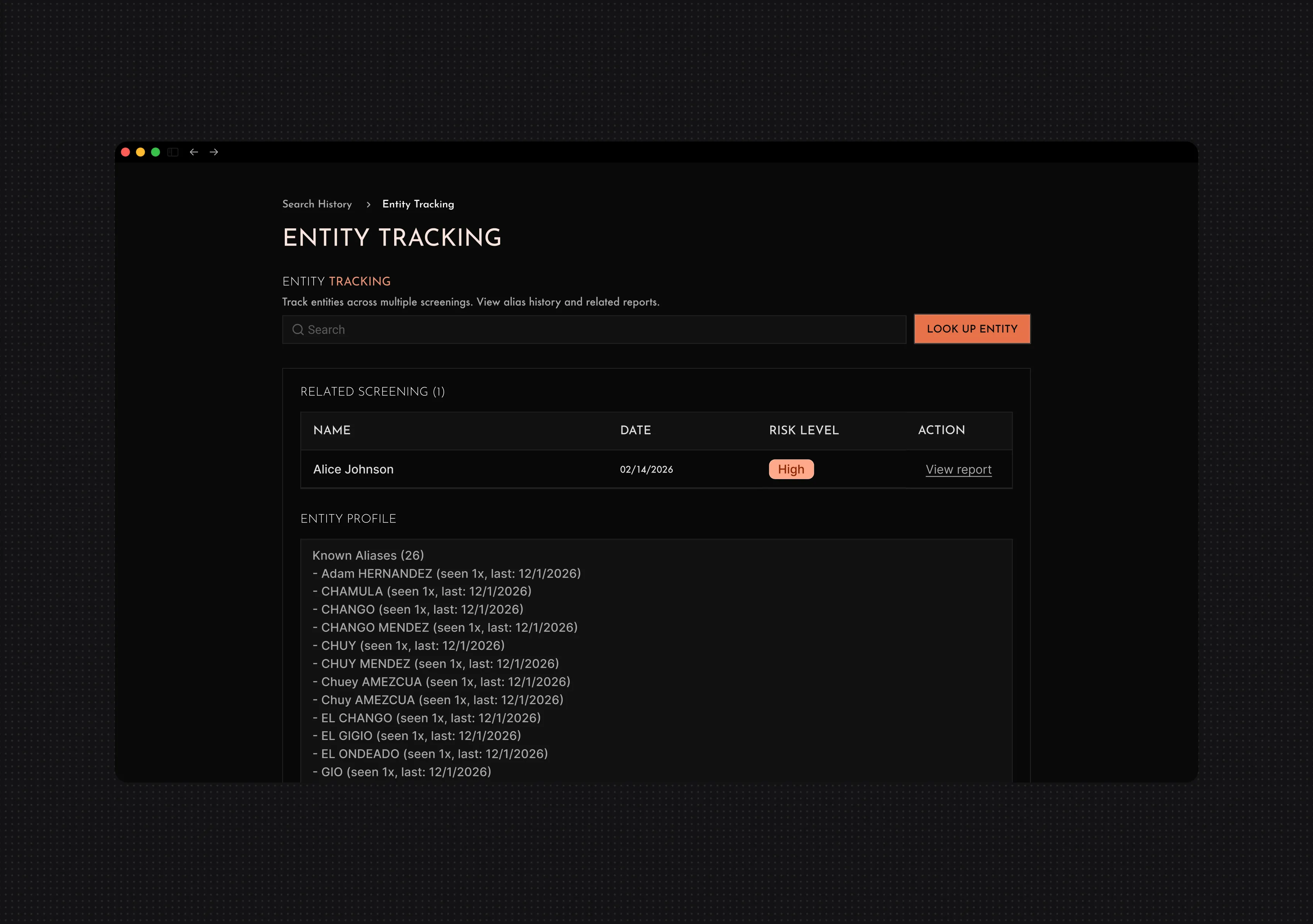
A "RELATED SCREENING" table. Each row is a related entity with its own risk score. The analyst sees the full network in one screen.
Can I trust this?
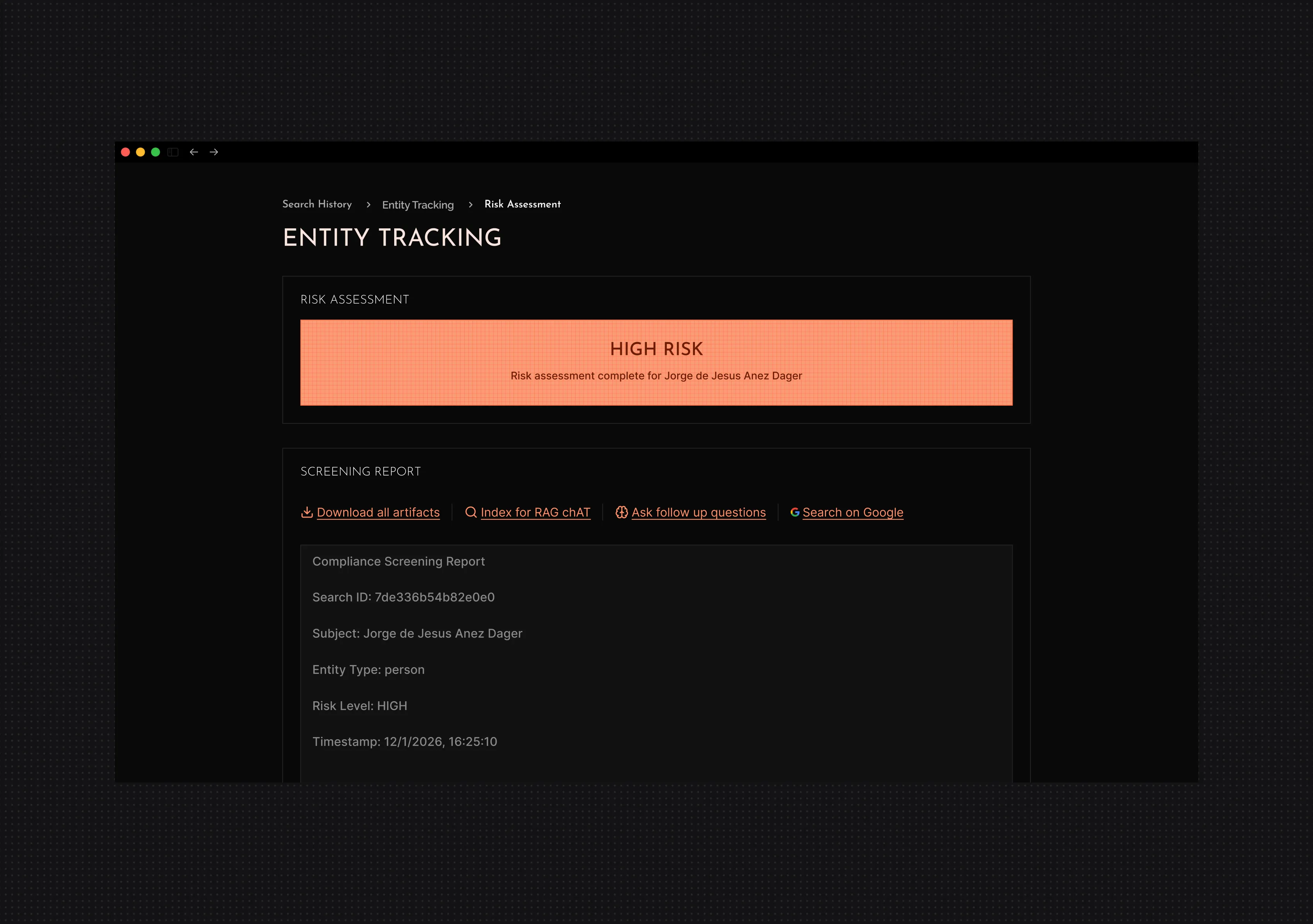
The result isn't just a number. It's a card showing what triggered it, offering concrete actions: download artifacts, ask the AI follow-up questions, verify on Google. The analyst can verify, question, investigate in parallel.
Who decides?
A form where the analyst chooses: accept, reject, or escalate. That decision gets recorded with a timestamp and their name. It's part of the audit trail. It's not "the AI decided." It's "the AI found this, the analyst reviewed it, the analyst decided."
Entity tracking
This is what the analyst sees. The related entities they need to investigate. Each row is a question. Expandable. The analyst controls how far down they dig.
Risk Assessment — The Result
Where the analysis ends. The red card is impossible to miss: "HIGH RISK." But it's not "High Risk, goodbye." Below are actions. Download the work. Ask more questions. Verify yourself. The analyst has control.
Outcome
Built to replace a manual process that took several analysts and days per case. Now: one screening with verifiable sources and recorded human judgment.
But what actually changed was the reasoning. An AI system doesn't gain trust by showing results—it gains trust by showing its work. The human isn't there to approve what the machine decides. They're there to decide based on what the machine found.
That's the difference. And it's everything.
More project's